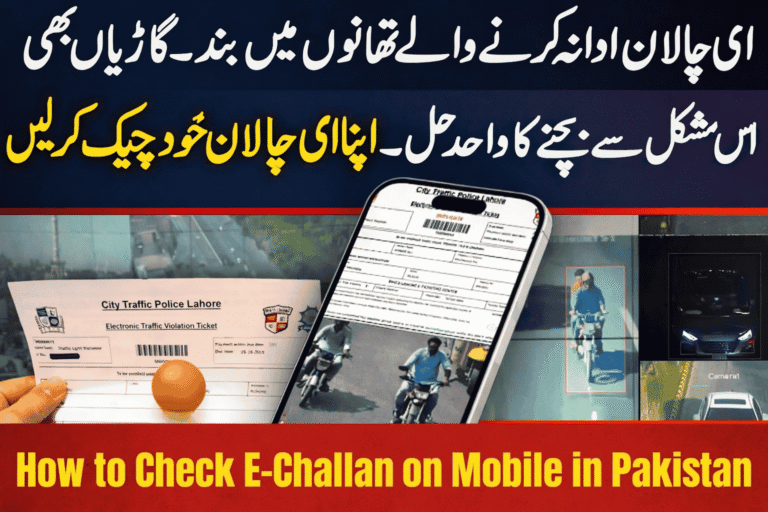
Karachi Traffic Revolution 2026: Commissioner Approves E-Challans for Illegal Parking
For decades, driving in Karachi has felt like navigating an obstacle course. Service lanes turned into private garages, footpaths doubled as motorcycle stands, and “double parking” was just the accepted norm at Tariq Road and Saddar.
That changes now.
In a landmark decision that officially kicks off the 2026 smart enforcement era, Commissioner Karachi Hassan Naqvi has given the final approval for Illegal Parking E-Challans. This is not just a plan on paper—it is an active, technology-driven crackdown designed to reclaim Karachi’s roads from the chaos of illegal parking.
The days of arguing with a traffic warden are over. Now, a silent digital eye is watching, and the fine will reach your phone before you even return to your car.
The Big Update: What Was Decided?
During a high-level strategic meeting attended by DIG Traffic Pir Mohammad Shah, the Municipal Commissioner, and key Deputy Commissioners, the administration finalized the shift from manual tickets to a fully automated digital penalty system.
The consensus was clear: Manual fines are too slow and prone to “negotiation.” To fix the gridlock in 2026, the law must be applied instantly and without bias.
Key Highlights of the Decision:
- Target: Vehicles blocking service lanes, main roads, footpaths, and commercial district entrances.
- Technology: Integration of ANPR (Automatic Number Plate Recognition) cameras with the Safe City infrastructure.
- Scope: The rule applies to everyone—private cars, government officials, delivery trucks, and ride-hailing services (Uber/Careem/Indrive).
Why Now? The “Method to the Madness”
Why has the government taken such a strict stance in 2026? The data presented during the briefing was alarming. Illegal parking was identified as the #1 cause of traffic paralysis in Karachi, leading to:
- Ambulance Delays: Emergency vehicles losing critical minutes in gridlocks caused by double-parked cars.
- Commercial Losses: Customers avoiding markets like Bohri Bazaar and Hyderi due to lack of access.
- Pedestrian Danger: With footpaths occupied by bikes, pedestrians are forced to walk on the main road, leading to fatal accidents.
DIG Traffic Pir Mohammad Shah stated, “This system will bring order and discipline. It encourages the proper use of basement parking in commercial buildings and reduces encroachments blocking public movement.”
How the “Illegal Parking” E-Challan Works
The mechanism is sophisticated yet simple for the user. It removes human confrontation entirely.
- Detection: High-definition ANPR cameras, installed on smart poles and mobile surveillance vans, scan “Red Zones.”
- Verification: The system identifies a vehicle that has been stationary in a “No Parking” zone for more than a specific duration (e.g., 30+ seconds in a non-stopping zone).
- Issuance: A snapshot is taken, the number plate is read, and the challan is generated against the owner’s CNIC.
- Notification: An SMS is sent to the registered mobile number, and the fine is uploaded to the central database.
Warning for Motorcyclists: The cameras are calibrated to detect bikes parked on footpaths. If your bike is found blocking a pedestrian walkway, expect a fine.
The “Red Zones”: Where You Will Be Fined First
The rollout is strategic. The administration is prioritizing the areas with the worst congestion. If you are driving in these zones, park only in designated lots.
| Zone Priority | Key Areas |
| Zone A (High Alert) | Saddar (Empress Market, Regal Chowk, Bohri Bazaar) |
| Zone B (Commercial) | Tariq Road, Bahadurabad, Clifton (Teen Talwar, Boat Basin) |
| Zone C (Arteries) | Shahrah-e-Faisal (Service Lanes), University Road |
| Zone D (Industrial) | Korangi Industrial Area, Landhi Markets |
Export to Sheets
The Basement Parking Crackdown (A Holistic Approach)
You might ask, “Where should I park then?”
The government isn’t just fining people; they are creating space. The Deputy Commissioner South revealed a major breakthrough: 22 Commercial Buildings in Saddar have been forced to clear their basement parking lots.
For years, these basements were illegally used as warehouses or shops. They have now been reclaimed for their original purpose—parking. This move releases hundreds of parking spots back to the public, giving you a legal alternative to street parking.
How to Check Your Parking Fine Online (2026 Guide)
Since paper tickets are disappearing, you must proactively check your status.
- Visit the Portal: Go to the official Sindh Police or E-Challan website (e.g.,
sindhpolice.gov.pkorechallan-psca.pkequivalent for Sindh). - Enter VRN: Type your Vehicle Registration Number (e.g., ABC-123).
- Search: The system will display all pending fines, including “Illegal Parking” violations with date and time.
- View Proof: In many cases, you can see the photographic evidence of your car parked illegally.
The Cost of Negligence: Fines & Consequences
While the exact fine schedule is subject to periodic updates, the 2026 enforcement brings heavier penalties to deter habitual offenders.
- Financial Penalty: Fines for obstruction of traffic are significantly higher than simple moving violations.
- Blockage: Unpaid fines will block your vehicle tax payment. You cannot sell the car or renew its registration until the dues are cleared.
- Impounding: For repeat offenders who ignore multiple notices, the traffic police have the authority to wheel-lock or impound the vehicle.
FAQ: Your Questions Answered
Q: Can I park for “just 2 minutes” to buy something? A: If it is a “No Parking” zone, no. The cameras do not know you are “just buying bread.” If the lane is blocked, the challan is issued.
Q: What if I was sitting inside the car? A: If you are stopped in a “No Stopping” zone (like a red line or main carriageway) and impeding traffic, you can still be fined for obstruction, even if you are inside.
Q: Are government number plates exempt? A: No. The Commissioner explicitly stated that Government Vehicles are included in the eligibility list. The fine will be sent to the relevant department.
Conclusion: A Step Towards a Civilized City
The implementation of the Karachi Illegal Parking E-Challan is a bitter pill to swallow for some, but a necessary cure for the city’s traffic ailment. By removing human bias and enforcing rules 24/7, Karachi is moving towards a future where roads are for driving, not parking.
The advice for 2026 is simple: Respect the red lines, use the designated parking lots (even if you have to walk a bit), and keep your digital record clean.
Drive safe, park smart, and avoid the E-Challan!