Punjab Traffic Fines 2026: The Complete Guide to the Digital Enforcement Era
Introduction: Welcome to the “Zero-Tolerance” Year
Happy New Year, Punjab. As the sun rises on 2026, the grace period is officially over.
If you have been following the news late last year, you know that the Punjab Government, led by the vision of a “Smart Province,” teased a massive overhaul of traffic laws. Those were not empty threats. As of today, the Punjab Traffic Reforms 2026 are fully active, and they are unlike anything we have seen in Pakistan’s history.
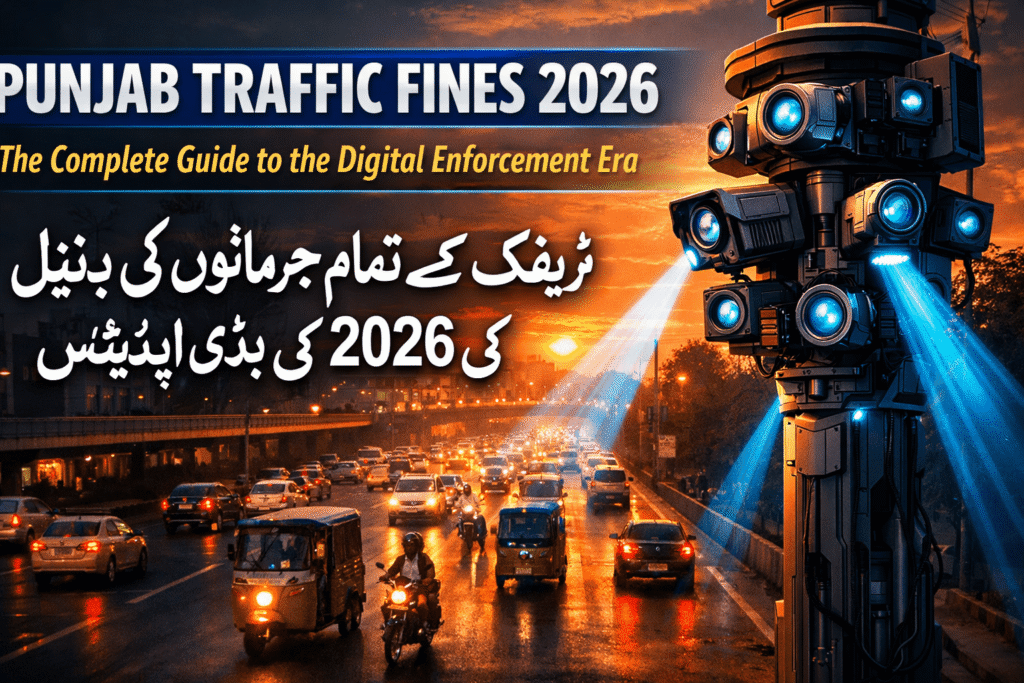
Gone are the days when a traffic violation was a minor inconvenience solved by a quick argument on the roadside. In 2026, the traffic warden has been replaced by an unblinking eye: Artificial Intelligence.
This guide is your roadmap to navigating this new reality. We aren’t just going to tell you how much the fines are (though we will cover that in detail); we are going to explain how the new DLIMS Digital Tracking System works, why your driving history now determines your social credibility, and how to avoid getting blacklisted.
| Violation Type | 2026 Fine (1st Offense) | Repeat Offense Risk | Risk Level |
|---|---|---|---|
| Traffic Signal Violation Crossing red light / Zebra crossing stop |
Rs. 5,000 | Rs. 15,000 + License Suspended | Critical |
| Overspeeding Exceeding limit on Ring Road/Canal |
Rs. 2,500 | Fine Doubles Automatically | Critical |
| Underage Driving Driver under 18 years |
Rs. 5,000 | Vehicle Impoundment | Critical |
| Driving Without License | Rs. 2,000 | FIR Registration (Section 97) | High |
| One-Way Violation | Rs. 2,000 | Rs. 15,000 (Habitual) | High |
| Improper/Fancy Number Plate | Rs. 2,000 | Confiscation of Plate | Medium |
| No Helmet / Seatbelt | Rs. 2,000 | Mandatory Safety Class | Medium |
| Using Mobile Phone | Rs. 2,000 | Fine Increases + Points Deduction | Medium |
| Tinted Windows | Rs. 2,000 | Immediate Removal + Fine | Medium |
1. The Core Shift: From Manual Challans to Digital Profiles
To understand the fines, you must first understand the system. In previous years, a challan was a piece of paper. You paid it, and it vanished.
In 2026, your car and your license have a “Credit Score.”
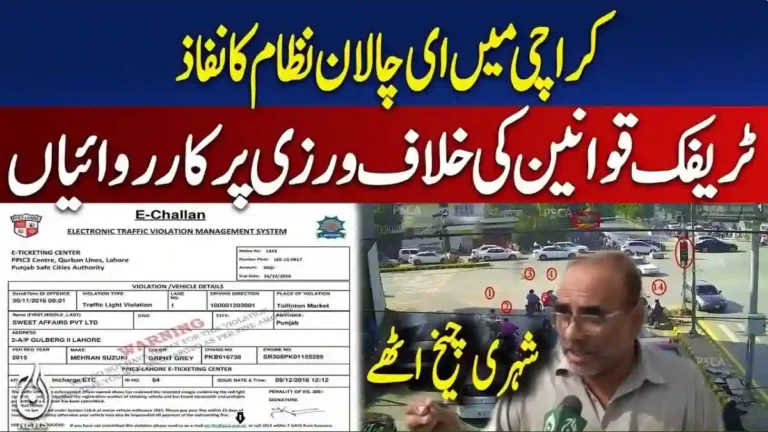
The Punjab Information Technology Board (PITB), in collaboration with Traffic Police, has launched the Unified Driver Profile. Every time you run a red light, overspeed, or drive without a seatbelt, it is logged in a central database linked to your CNIC.
Why is this dangerous for violators?
- The Data Trail: Insurance companies in Pakistan are now beginning to access this data to determine premiums. A bad driving record means expensive car insurance.
- No “Safarish”: The e-challan system is automated. If a camera captures you, the challan is generated instantly. No phone call to a “connection” can delete a record that is already on the server.
2. The 2026 Fine Structure: A Financial Shock
The government’s strategy for 2026 is financial deterrence. The fines have not just doubled; in some cases, they have increased by 500% to 700%.
Here is the detailed breakdown of the penalties enforced across Lahore, Rawalpindi, Faisalabad, Multan, and Gujranwala effective immediately.
A. The “Big Three” (High Priority Violations)
These are the violations that the Safe City Cameras are programmed to catch most aggressively.
| Violation | Section | 2026 Fine (1st Offense) | Severity |
| Traffic Signal Violation | 98A | Rs. 5,000 | 🔴 Critical |
| Overspeeding | 99A | Rs. 2,500 | 🔴 Critical |
| Underage Driving | 99B | Rs. 5,000 + Impound | 🔴 Critical |
Analysis: The Rs. 5,000 fine for jumping a red light is aimed at curbing the leading cause of intersection accidents. Note that “jumping” now includes stopping on the zebra crossing line.
B. Documentation & Compliance
The days of driving without papers are over. The new E-License verification allows wardens to scan your face or thumbprint to pull up your record.
- Driving Without License: Rs. 2,000 (Plus FIR under Section 97 in severe cases).
- Driving Without Registration Book: Rs. 2,000.
- Improper/Fancy Number Plate: Rs. 2,000.
Pro Tip: The cameras cannot read fancy, italicized, or small number plates. If the AI fails to read your plate, it flags your vehicle for a manual stop. This is why “Applied For” or customized plates are heavily targeted in 2026.
C. Safety & Discipline
- One-Way Violation: Rs. 2,000 (This is now considered a criminal offense in some zones).
- No Helmet (Motorcycle): Rs. 2,000.
- No Seatbelt (Car): Rs. 2,000.
- Using Mobile Phone while Driving: Rs. 2,000.
- Tinted Windows: Rs. 2,000 (Plus on-spot removal).
3. The “Repeat Offender” Matrix: The Trap You Must Avoid
This is the most unique and dangerous part of the 2026 legislation. The government has introduced a Progressive Penalty Mechanism.
If you are caught committing the same violation within a specific timeframe (usually 60 days), the fine does not stay the same. It skyrockets.
The Escalation Ladder:
- First Offense: Standard Fine (e.g., Rs. 2,000).
- Second Offense: The “Habitual” Multiplier kicks in. The fine can jump to Rs. 15,000.
- Third Offense:
- License Suspension: Your license is digitally blocked for 3 to 6 months.
- Refresher Course: You must attend a mandatory 3-day traffic discipline class at police lines to reinstate your license.
This system is designed to break the mindset of wealthy drivers who believe they can simply “afford” to break the law.
4. How the Tech Works: DLIMS and e-Challans
You might be wondering, “How do they know it was me?”
The ANPR Camera Grid
Major cities in Punjab are now blanketed with Automatic Number Plate Recognition (ANPR) cameras. These aren’t just video recorders; they are computers.
- They calculate your speed between two points.
- They detect if you are not wearing a seatbelt (using high-res zooming).
- They cross-reference your number plate with the excise database in milliseconds.
The e-Challan Portal 2.0
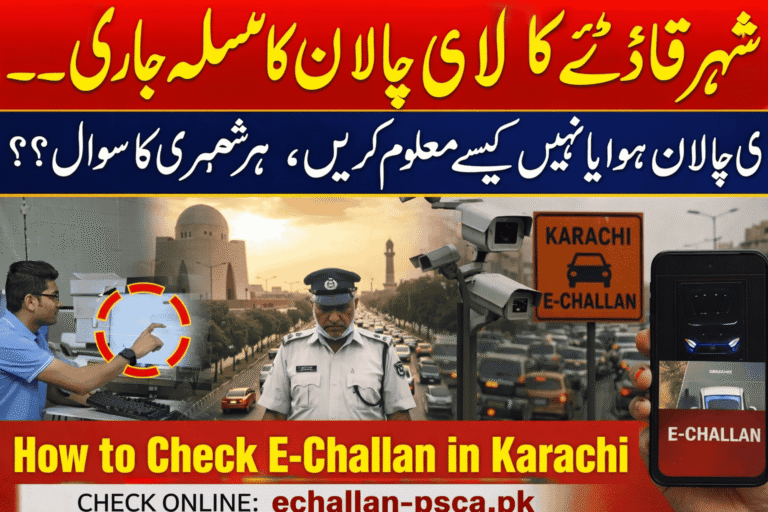
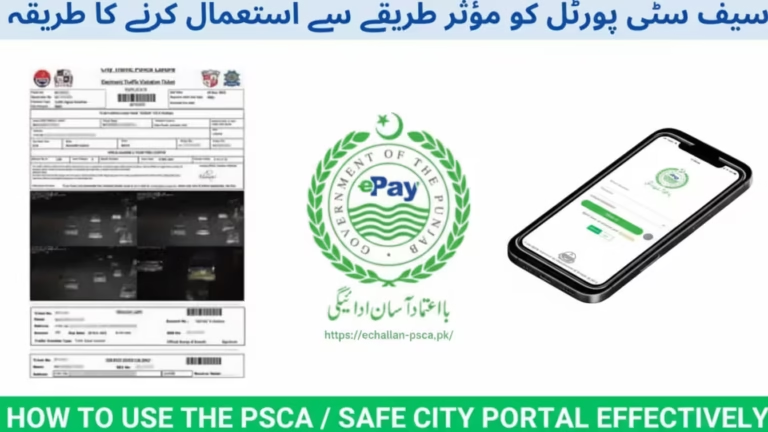
The website echallan-psca.pk and the Punjab Police App have been updated.
- Real-Time Alerts: You should receive an SMS within minutes of a violation.
- Photo Proof: You can log in and view the high-definition image of your car committing the violation.
5. Survival Guide: How to Drive in Punjab in 2026
The environment is strict, but compliant drivers have nothing to fear. Here is how to ensure you don’t lose your hard-earned money to fines this year.
Step 1: Verify Vehicle Ownership
This is the biggest pitfall. If you bought a car on an “Open Letter” and never transferred it, do it now. If the previous owner gets your fines, they can file a complaint, leading to your car being impounded as “stolen” or “suspicious.”
Step 2: The “Line Discipline” Rule
The new cameras are calibrated to detect Lane Straddling. Do not drive in the middle of two lanes. Stick to your lane. On the highway, the left lane is for slow traffic, and the right is for overtaking. Lane discipline violations are the “silent killers” of your wallet.
Step 3: Weekly Status Check
Make it a habit to check your status online every week.
- Go to the official e-challan website.
- Enter your Vehicle Registration Number.
- Enter your CNIC.
- Clear any pending dues immediately. Unpaid fines can prevent you from paying your annual Token Tax.
Conclusion: A Culture Shift
The Punjab Traffic Fines 2026 are harsh, expensive, and strict. But looking at the bigger picture, they are necessary.
For too long, our roads have been chaotic. The loss of life due to overspeeding and signal violations in Punjab was reaching a crisis point. This digital crackdown forces us to be civilized not because we want to, but because we have to.
Your Resolution for 2026:
Don’t just drive to reach your destination; drive to protect your record. Respect the signal, stay in your lane, and treat the road with the discipline it demands.
Stay safe, drive smart, and keep your digital record clean!
Frequently Asked Questions (FAQs)
Q: Can I challenge an e-challan in 2026?
A: Yes. The new portal has a “Grievance Redressal” section. If you believe the camera made an error (e.g., cloned number plate), you can submit a request with evidence.
Q: What happens if I don’t pay the fine?
A: Unpaid fines accumulate. After a certain threshold, your vehicle will be flagged. You will be stopped at the next checkpoint, and your vehicle may be impounded until all dues are cleared.
Q: Are these fines applicable on the Motorway?
A: No. The Motorway Police (NHMP) has its own jurisdiction and fine structure. These fines apply to Punjab District Traffic (GT Roads, City Roads, Ring Roads).